
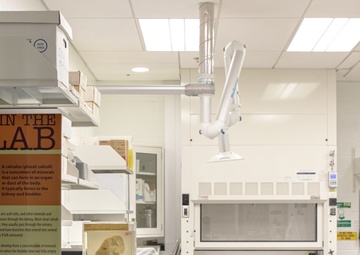
Photo by Kevin Sommer Giron | National Museum of Health and Medicine | 12.01.2024
An exhibit titled “In the Lab: Kidney and Bladder Calculi (Stones)” is on display in Dec. 2024 at the National Museum of Health and Medicine in Silver Spring, Maryland. (National Museum of Health and Medicine Photo by Kevin Sommer-Giron.)...
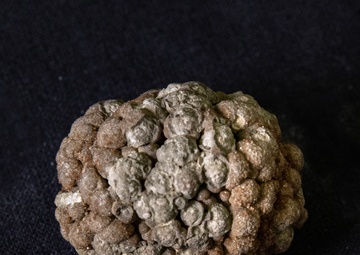
Photo by Kevin Sommer Giron | National Museum of Health and Medicine | 11.19.2024
This is a mulberry calculus that was removed from the bladder of a hog in 1876. Mulberry calculi are named for their resemblance to the mulberry fruit. [AMM PS 6621] (National Museum of Health and Medicine Photo by Kevin Sommer Giron.)...
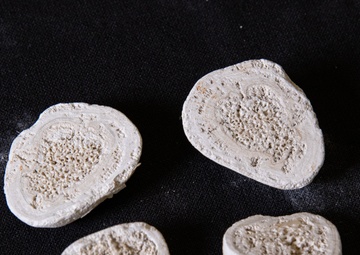
Photo by Kevin Sommer Giron | National Museum of Health and Medicine | 11.18.2024
These are bladder calculi that were removed from the bladder of a 19-year-old male at autopsy. Private John Mahay was wounded at the Second Battle of Bull Run in 1862 when a bullet passed through his lower torso and lacerated the bladder. The injured bladder was unable to function properly. As he lay dying, Mahay was often visited by poet Walt Whitman who was serving as a Civil War nurse. [AMM......
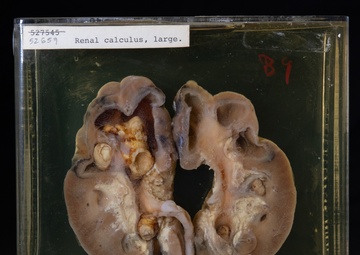
Photo by Kevin Sommer Giron | National Museum of Health and Medicine | 11.18.2024
This is a sectioned kidney with a staghorn calculus. The calculus impaired the normal functions of this kidney. [AFIP 52659] (National Museum of Health and Medicine Photo by Kevin Sommer Giron.)...
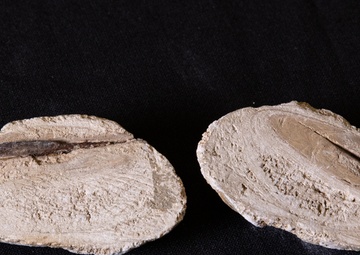
Photo by Kevin Sommer Giron | National Museum of Health and Medicine | 11.18.2024
This is a bladder calculus caused by an iron arrowhead. The arrowhead penetrated the bladder cavity of a 42-year-old male in 1862 and remained in place for seven years. As the calculus developed more layers, it began to interfere with urination. The calculus was removed by lithotomy in 1869. [AMM PS 5931] (National Museum of Health and Medicine Photo by Kevin Sommer Giron.)...
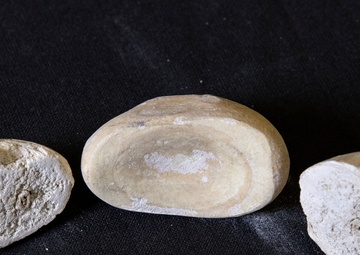
Photo by Kevin Sommer Giron | National Museum of Health and Medicine | 11.18.2024
These are bladder calculi that were removed from the bladder of a 26-year-old male who died at Fort Union, New Mexico, 1875. These bladder calculi obstructed the urinary tract and resulted in hydronephrosis, a swelling of the kidneys caused by a backup of urine. [AMM PS 6526] (National Museum of Health and Medicine Photo by Kevin Sommer Giron.)...
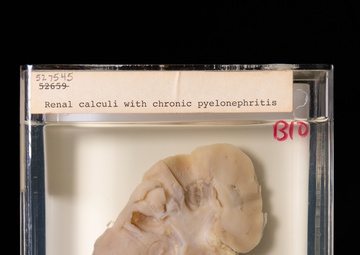
Photo by Kevin Sommer Giron | National Museum of Health and Medicine | 11.18.2024
This is a sectioned kidney with a staghorn calculus. Staghorn calculi can block the flow of urine and increase the potential for serious urinary tract infections. [AFIP 527545] (National Museum of Health and Medicine Photo by Kevin Sommer Giron.)...
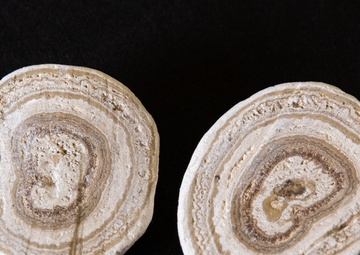
Photo by Kevin Sommer Giron | National Museum of Health and Medicine | 11.18.2024
This is a bladder calculus that was removed from the bladder of a 19-year-old male with a history of chronic bladder inflammation. [AMM PS 14402] (National Museum of Health and Medicine Photo by Kevin Sommer Giron.)...